How to choose windows for a private house: energy efficiency and profiles
Video of the Vikna VOVIN company
March 2, 2018 at 1:54 AM
2181

How to choose windows for a private house — an overview of energy-efficient metal-plastic (PVC) windows: what drives a home's heat loss and which profile systems suit different insulation levels.
What the video shows
- How a house loses heat: floors and basement — 3–9%, roof — 11–18%, ventilation — 10–15%, walls — 18–25%, windows and gaps — 25–47%.
- A window's energy efficiency is defined by its heat-transfer resistance coefficient, which should be no lower than 0.75.
- Standard: a 5-chamber profile with 70 mm depth (e.g. REHAU Euro-Design 70), steel reinforcement from 1.5 mm, a double-chamber insulating glass unit of 40 mm with argon and at least one low-emissivity pane — over 2.5× warmer than an old timber window.
- Premium: a 6–7-chamber profile with 80 mm depth (e.g. REHAU Synego), a double-chamber IGU up to 44 mm with argon, two low-e panes, 2–3 sealing contours — over 3× warmer.
- For homes with passive heating: a 6-chamber profile with 86 mm depth (e.g. REHAU GENEO) that in most cases needs no steel reinforcement, a double-chamber IGU up to 52 mm with krypton, two low-e panes, three sealing contours — 5× warmer.
- Window quality also depends on correct installation with vapour- and water-proofing materials.
- Energy-efficient windows help in summer too — they keep the cool in and save on air conditioning.
This approach helps compare profile systems, insulating glass units and hardware of different classes and match windows to a specific house and climate.
Company Vikna VOVIN
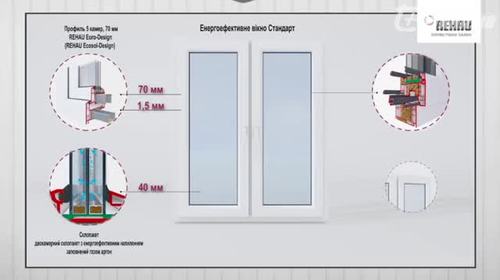
How to choose windows for a private house: energy efficiency and profiles
How to choose windows for a private house — an overview of energy-efficient metal-plastic (PVC) windows: what drives a ...