Smart glass without the myths: where it works and where it does not
Glass that can switch from clear to opaque in a fraction of a second is no longer exotic: it is used in meeting rooms, bathrooms, office partitions and terraces. Yet there is still more confusion around it than hard facts — smart glass is often marketed as a universal solution to overheating, even though some technologies genuinely control how much solar energy and visible light enters a room, while others merely block the view. They are often confused with one another.
We explain what actually happens to the glass when it switches, how PDLC, PNLC and DLC differ, what happens during a power cut, which parameters to look for in a specification, and when ordinary frosted glass or roller shutters can do the same job for less. The specific solution for your opening should be selected by the contractor — this article provides the background you need to discuss the options with them in practical terms.
- What smart glass is and how it switches
- PNLC and reverse-mode films
- PDLC, PNLC and DLC: three families of liquid crystal glass
- Other switchable glass technologies: electrochromic, thermochromic, photochromic and SPD
- Glass or film: two ways to create a smart surface
- Which parameters to check in the specification
- What happens during a power cut
- Where smart glass genuinely makes sense and where cheaper solutions are better
- Limitations to understand before ordering
- Regulatory framework
- How much it costs and how to choose a contractor
- Frequently asked questions
What smart glass is and how it switches
Smart glass (glass with variable or controllable transparency) is glass whose optical properties change under an external stimulus such as voltage, temperature or light. In everyday use, when people refer to “smart glass”, they almost always mean the widely used PDLC — polymer dispersed liquid crystal.
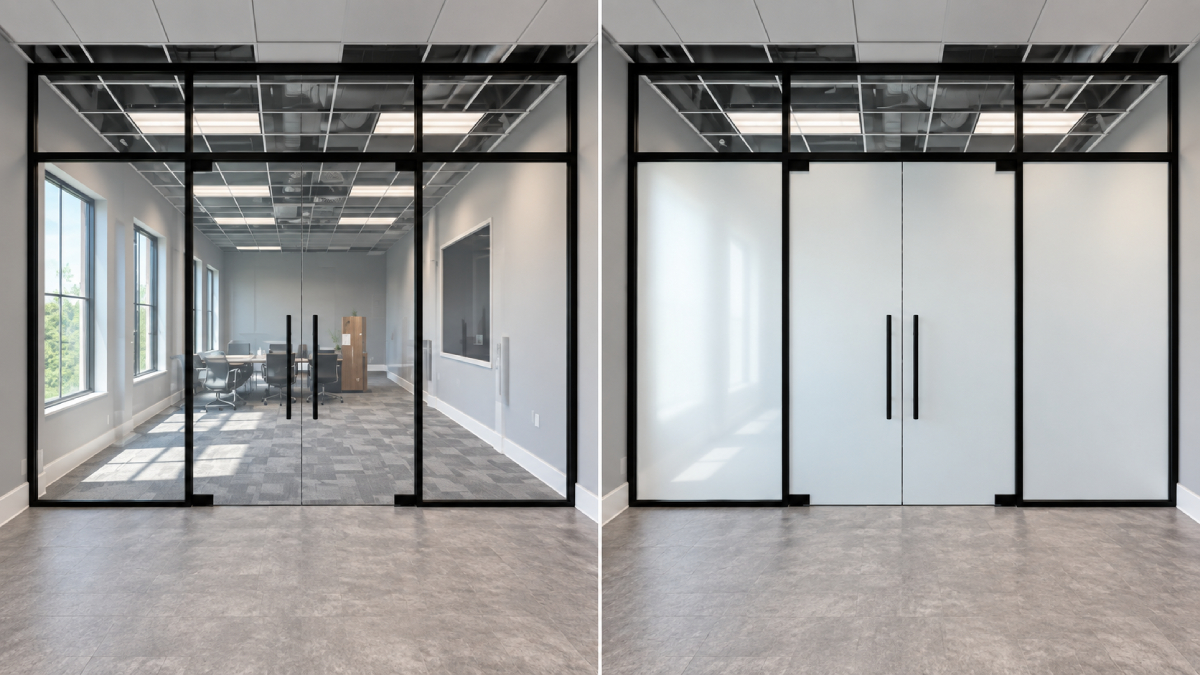
The physics is straightforward. Microscopic droplets of liquid crystals are evenly dispersed within a thin polymer layer. With no voltage applied, the crystals in each droplet are randomly oriented and their refractive index does not match that of the polymer. Light is therefore scattered at each interface, making the surface appear milky white. As soon as an alternating voltage is applied to the transparent conductive layers, the crystals align with the electric field, the scattering disappears and the glass becomes transparent. Remove the voltage and the panel returns to its opaque state in a fraction of a second.
The key characteristic is that PDLC changes haze rather than light transmittance. According to the manufacturer, white PDLC film transmits around 90% of light in its transparent state and around 83% in its opaque state, while haze rises from approximately 2.4% to 95%. In other words, when switched off, the panel still lets through almost as much light, but objects can no longer be seen through it: the light passes through but is scattered, much like through a frosted light diffuser. This applies to both PDLC and PNLC: they provide privacy, not dimming. The technology that genuinely reduces light and heat transmission is DLC, dye liquid crystal, which is discussed separately below.
PNLC and reverse-mode films
PNLC has characteristics similar to PDLC and also switches between transparent and opaque states, but its main distinction is its reverse operating mode. When switched off, with no voltage applied, the film is transparent; when switched on, it becomes opaque.
PDLC is used where privacy is required for longer periods or where privacy must be maintained without power. Where the opposite is true and privacy is needed only for shorter periods and only when actively switched on — for example, in offices or conference rooms — PNLC can be the more appropriate choice.
PDLC, PNLC and DLC: three families of liquid crystal glass
All three are based on the same basic principle: liquid crystals in a laminate controlled by an alternating voltage, with switching taking place almost instantaneously. The difference is what exactly is being switched — visibility or light. This is the source of much of the confusion in discussions with suppliers, so the three families are best compared using the same criteria.
- º What switches. PDLC — the orientation of liquid crystal droplets within the polymer, which determines how light is scattered. PNLC — the same principle, but with the electric-field logic reversed. DLC — the orientation of liquid crystals together with dichroic dye molecules, which rotate with them and absorb light.
- º States. PDLC and PNLC: transparent ↔ milky opaque. DLC: tinted transparent ↔ deeply darkened, with virtually none of the frosted appearance.
- º What changes physically. In PDLC and PNLC, it is haze, while light transmittance remains almost the same. In DLC, it is the light transmittance itself, which falls several-fold.
- º Behaviour without power. PDLC — opaque. PNLC — transparent. DLC — dark.
- º Sun and overheating. PDLC and PNLC have very little effect on either: light is scattered rather than blocked. DLC reduces solar heat gains through genuine dimming — subject to the qualifications discussed below.
- º Typical applications. PDLC — partitions, meeting rooms, bathrooms. PNLC — shopfronts, entrance areas and terraces where transparency during a power cut is critical. DLC — panoramic glazing, roof windows, bedrooms or home cinemas, and areas affected by excessive brightness and glare.
- º Main limitation. PDLC does not dim. PNLC consumes power precisely when privacy is required. DLC requires voltage to remain in its lighter state — during a power cut, the room becomes darker.
PDLC — the most common option. PDLC is what is usually meant when “smart glass for a partition” is offered. It provides almost instantaneous switching and high haze in the opaque state, making even nearby silhouettes difficult to distinguish. The trade-off is continuous power: electricity is consumed for as long as the glass must remain transparent. It can be controlled by an ordinary switch, push button, relay or building automation system — this is determined as part of the electrical design.
PNLC (reverse mode) — transparent without power. The logic is reversed: without voltage, the panel is transparent, and when voltage is applied it becomes opaque. This is more practical where transparency is critical — for example, in a shopfront, vestibule, entrance area or terrace. The drawback is that electricity is consumed precisely when privacy is required, which is often in the evening and at night.
DLC — dye liquid crystals: genuine dimming. DLC (dye liquid crystal) works according to the same liquid-crystal principle, but dichroic dye molecules are added to the layer. They rotate together with the crystals: when aligned edge-on to the light they allow it through, and when rotated across the light path they absorb it. This is a guest-host system in which the dye “guest” follows the movement of the liquid crystal “host”.
The fundamental consequence is that light transmittance itself changes rather than haze. The view through DLC therefore remains sharp — it tints rather than “frosts”. According to the manufacturer, in the transparent state the panel transmits around 36% of light and in the dark state around 4.5% for a 1:8 contrast ratio; in the 1:15 version, the figures are 28% and 1.5%. This is why DLC is specified by contrast ratio rather than by film colour, as is commonly done with PDLC.
This also explains its energy-performance advantage: DLC reduces excessive brightness, glare and solar heat gains through genuine dimming. The dye partly absorbs light and partly reflects solar energy, meaning that the glass itself heats up and releases some of that heat into the room. The solar factor g is calculated in accordance with EN 410 for the specific insulating glass unit (IGU) configuration. At present, specific IGU performance data are not yet available.
Important. All three types of smart glass operate exclusively on alternating voltage of 48 or 65 V. Direct voltage, or even a DC component within an AC supply, damages the film irreversibly. Because the crystals can move within the polymer, a DC component causes crystal drift and distorts the optical properties.
Other switchable glass technologies: electrochromic, thermochromic, photochromic and SPD
Liquid-crystal technology is not the only form of switchable glass. Four other technologies operate according to different physical principles — and these are often confused with PDLC. They differ in what they change, whether continuous power is required and how they behave when no electricity is available.
- º Electrochromic — retains its last state without power; changes light transmittance, providing genuine dimming; switches noticeably more slowly; bistable. Used in façades, roof windows and panoramic glazing where solar control is required.
- º Thermochromic — passive, with no active control; responds to the temperature of the glass itself; requires no power. Used in roofs and conservatories.
- º Photochromic — passive and responds to ultraviolet radiation; of limited effectiveness in glazing.
- º SPD — suspended particles; provides continuously variable dimming; requires continuous power to remain in the light state. Used in transport applications and premium glazing.
Electrochromic glass — slow dimming that retains its state. This technology uses thin layers of metal oxides rather than liquid crystals. A reversible electrochemical reaction occurs within them under low DC voltage. The glass genuinely darkens, reducing light transmittance and solar gain rather than merely scattering light. The second fundamental difference is that it is bistable: energy is needed only for the transition, after which the selected state is retained without power. The trade-off is speed: switching is significantly slower than with PDLC, and the larger the panel, the longer it generally takes to darken. DLC and electrochromic glass can provide dynamic solar control; PDLC cannot. Exact switching times and percentages depend on the specific product.
Thermochromic and photochromic glass — passive, with no active control. Thermochromic glass changes its properties depending on the temperature of the glass itself: it heats up in the sun and darkens, then becomes lighter again as it cools. Photochromic glass responds to ultraviolet radiation — the same principle used in photochromic spectacle lenses. Neither requires wiring or a switch, but neither can be actively controlled: you cannot switch on privacy in the evening or remove the tint on an overcast day. In an insulating glass unit (IGU), the photochromic effect is also limited because the glass itself and low-emissivity coatings block some of the ultraviolet radiation to which the material is supposed to respond.
SPD — continuously variable dimming. An SPD layer contains microscopic suspended particles which align under voltage and allow more light to pass through. Rather than offering just two states, the technology provides continuous adjustment from almost transparent to deeply darkened. Like PDLC, it requires continuous power to remain in its lighter state.
Glass or film: two ways to create a smart surface
Controllable transparency can be achieved in two ways, and the practical implications are very different.
- º Laminated smart panel. The film is laminated between two panes of glass at the factory, creating laminated glass — essentially a triplex structure with a liquid crystal interlayer. It looks like ordinary glass, while the film is protected from moisture and mechanical damage. The edge containing the electrodes is brought out at a pre-agreed location. The panel is manufactured strictly to size: it cannot be trimmed or drilled on site. A laminated panel can be incorporated into an insulating glass unit (IGU) and then installed in windows and façades.
- º Self-adhesive smart film. This is applied to existing glass and is the only way to add controllable transparency to installed glazing without removing it. It is cheaper and quicker, but the result depends heavily on the condition of the glass and the quality of installation: bubbles, dust beneath the film and visible edges may occur. The film remains exposed on the surface, so it is easier to damage during cleaning, and a cable connection is still required.
Repairability also differs: film can be replaced, whereas a laminated panel can only be “repaired” by replacing the entire unit. A simple rule is that if smart glass is being specified for new glazing, a laminated panel is usually the more logical option; if privacy needs to be added to an existing partition or window, film is the more practical solution.
Which parameters to check in the specification
Offers from different suppliers can only be compared properly if the same parameters are stated. The specification should include the following:
- º Light transmittance in both states — not only in the transparent state: comparing the two figures shows whether the glass genuinely dims or merely obscures the view.
- º Contrast ratio — the key ordering parameter for DLC: not the film colour, but the ratio between the light and dark states, for example 1:8 or 1:15.
- º Haze in the transparent state — the lower the figure, the “cleaner” the panel appears when transparent. This is particularly noticeable when glass panels are viewed at an acute angle.
- º Switching speed in both directions — switching is not symmetrical: transition to transparency is usually faster than the return to the opaque state.
- º Operating voltage and current type — PDLC operates on alternating current supplied through a transformer or specialised AC power supply.
- º Power consumption per square metre — with clarification as to which operating state the figure applies.
- º Maximum panel size — this determines whether unnecessary joints can be avoided in a partition.
- º Operating temperature range — critical for an unheated terrace, balcony or shopfront.
- º Switching life — the number of cycles the product is designed to withstand.
- º Weight per square metre — this determines the load on the structure, hinges and guides.
Manufacturers publish these ranges in publicly available specifications. For example, the US manufacturer PriWatt specifies an operating voltage of approximately 48–65 V AC for its PDLC products, with laminated glass at around 60 V, 50/60 Hz; power consumption of up to approximately 5 W/m² and only in the transparent state; switching to transparency in a fraction of a second, down to approximately 10 ms, and back to opaque in up to approximately 200 ms; an operating temperature of -20…+60 °C for film and -10…+60 °C for laminated glass; a service life of more than 800,000 switching cycles for PDLC film and more than 600,000 for the other versions; a maximum PDLC film size of approximately 1,830 × 3,630 mm; and a laminate weight of around 24 kg/m². For DLC, the same manufacturer gives a different set of figures: light transmittance of around 36% in the transparent state and around 4.5% in the dark state at a 1:8 contrast ratio, or 28% and 1.5% respectively at 1:15; haze in the transparent state of around 2.4–3%; faster switching into the dark state than back into the light state, at less than 5 ms versus less than 150 ms; an operating voltage of 60–65 V; and the same power consumption, applying only in the light state. The maximum DLC panel size differs from that of PDLC and should therefore be confirmed with the supplier. Figures will vary between suppliers: these are data from one manufacturer rather than an industry standard.
A separate point concerns acoustics. The liquid crystal layer does not in itself “add” sound insulation: acoustic performance depends on the complete construction — the thickness of the glass panes, the cavity and the type of laminating interlayer. It is assessed for the specific construction according to European methodology (DSTU EN 12758, DSTU EN ISO 717-1), and the manufacturer should provide a figure for the exact configuration being offered.
What happens during a power cut
For Ukraine, this is not an abstract question. The answer depends on the operating mode of the panel.
- º Standard PDLC becomes opaque when there is no voltage. In a home or office, this is more of an advantage: privacy is maintained automatically during a power cut.
- º PNLC (reverse mode) remains transparent without voltage. This is what is needed for a shopfront, entrance area, conservatory or terrace — anywhere where a milky opaque panel during a power cut could make the premises look closed.
- º DLC remains dark without voltage. In summer this effectively provides free shading, but during a daytime power cut the room will be dark and there is no way to change that. For a bedroom or home cinema this may be an advantage; for a home office it is more likely to be a disadvantage.
The operating mode is selected at the design stage: a finished PDLC product cannot be converted into reverse mode because these are different products. Another point is that smart glass is powered through a transformer, meaning that it remains dependent on the mains supply or a backup power source.
Where smart glass genuinely makes sense and where cheaper solutions are better
When it is justified
- º Deftech — a specialised field in which privacy and control of information are particularly important.
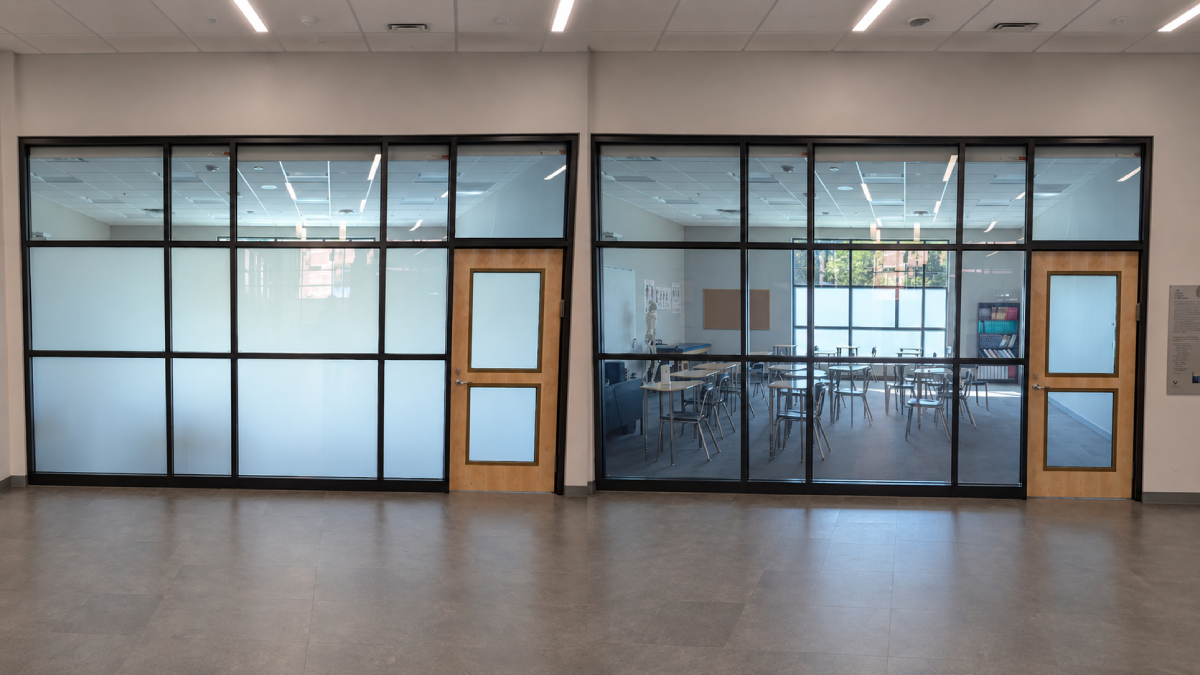
- º Office and internal glass partitions — an office or meeting room remains bright, while privacy can be switched on for the duration of a meeting.
- º Bathrooms and showers — a glass partition can replace a solid wall, with opacity activated when required.
- º Ground-floor windows or windows very close to a neighbouring building — where everything is visible from outside but you do not want to lose natural light.
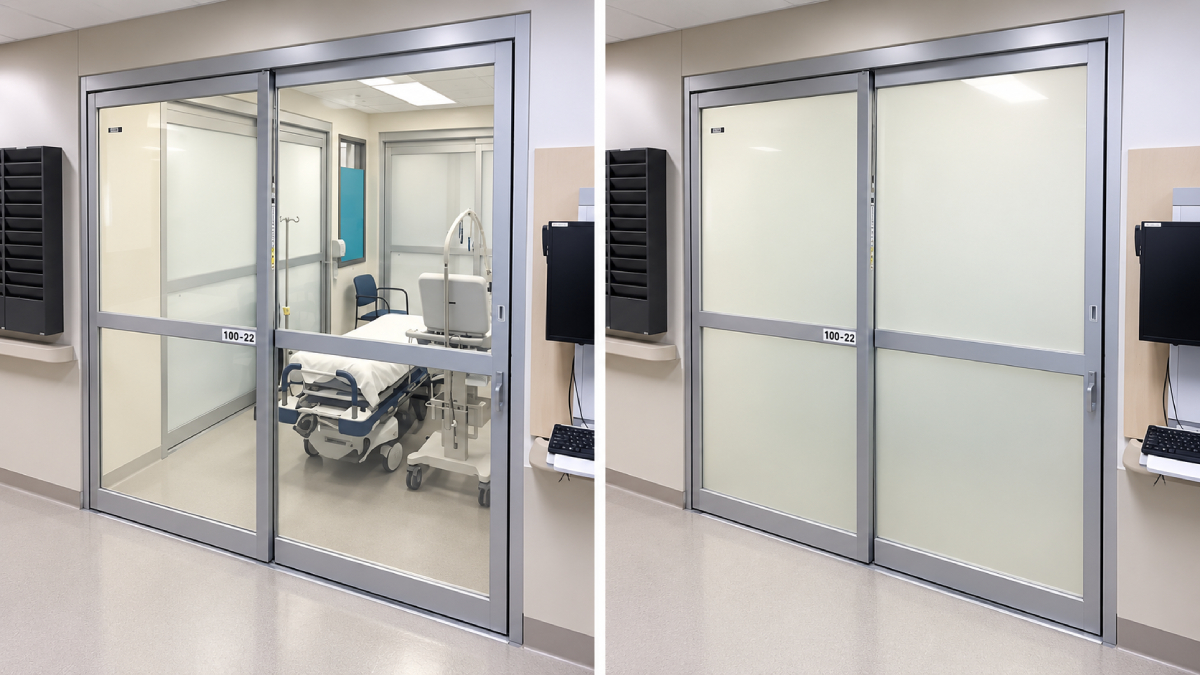
- º Medical and cosmetic treatment rooms and rooms containing documents — privacy can be activated for a specific procedure.
- º HoReCa and terrace glazing — temporary zoning of a room or creation of a private area for several hours.
- º Panoramic glazing, roof windows, bedrooms or home cinemas — where the issue is not privacy but light, glare and excessive brightness: DLC is the relevant technology here because it provides genuine dimming.
- º Projection surface — in the opaque state, the panel can function as a projector screen.
When cheaper solutions will do the same job
- º Privacy is required around the clock. If the glass is meant to remain opaque permanently, there is little point in switchability: frosted, satin-finished or textured glass is cheaper and requires no electricity.
- º The only issue is heat and sun. PDLC and PNLC provide practically no protection against overheating: the scattered light still enters the room. Solar-control glass, roller shutters, blinds and external shading systems are effective here and cost less. DLC can address this issue, but it makes most sense where there is a second requirement as well, such as privacy, on-demand dimming or glare control. Buying switchable glass solely for solar control is the most expensive way of solving the problem.
- º Limited budget. Conventional decorative or mirrored film can block the view at a fraction of the cost of a smart solution — simply without the switching function.
Limitations to understand before ordering
- º The panel cannot be cut or drilled on site. All dimensions and openings must be made at the factory; it cannot be “adjusted to fit” after delivery.
- º The electrical design must be defined before manufacture. The cable exit point, transformer location and control method must all be agreed before production begins.
- º Conductive busbar around the edge. A narrow strip around the perimeter must be concealed within a frame or profile — this is particularly important for frameless partitions and glass doors.
- º Operating temperature range. An unheated terrace, a shopfront exposed to direct sunlight or an area near a sauna should be discussed separately with the manufacturer.
- º Thermal performance is not determined by the liquid crystals. If a smart panel forms part of an external insulating glass unit (IGU), it is used as the inner pane, while thermal transmittance and solar factor are determined by the IGU itself: the number of cavities, gas filling and low-emissivity glass. DLC is a partial exception because it changes light transmittance itself and therefore affects solar gain. However, thermal transmittance and the final solar factor must still be calculated for the complete IGU, taking into account low-emissivity glass, cavity filling and the fact that heat absorbed by the dye warms the glass itself. The relevant performance figures are those for the complete construction, not for the film alone.
- º Repair means replacement. A damaged panel cannot be restored and must be replaced in full, so lead times for remanufacture and the manufacturer's continued availability of the same film should be considered in advance.
Regulatory framework
A laminated smart panel is laminated glass, so it is subject to the same Ukrainian standards as conventional laminated safety glass:
- º DSTU EN ISO 12543 — laminated glass and laminated safety glass: terminology, requirements and appearance.
- º DSTU EN 14449 — conformity assessment for laminated glass.
- º DSTU EN 12600 — pendulum testing and impact-resistance classification, commonly referred to as the safety class.
Light and thermal performance of an insulating glass unit (IGU) is calculated in accordance with EN 410 and EN 673 and the corresponding harmonised DSTU standards. The safety class is not a property of “smart glass in general”: it depends on the specific construction and must be stated by the manufacturer in the product documentation. The solar factor and light transmittance of a specific construction are calculated according to EN 410, while thermal transmittance is calculated according to EN 673.
How much it costs and how to choose a contractor
There is no single price “per square metre”, and any advertised figure without a specification is meaningless. Cost is influenced by the type of solution, whether self-adhesive film or a laminated panel; the size and number of panels; the film colour in the opaque state, or the selected contrast ratio for DLC; the control method, from a simple switch to integration with an automation system; the framing and fixing method; the extent of electrical work; as well as installation and delivery. Two quotations can only be compared properly when both specify the same parameters from the list above.
Frequently asked questions
1. Will smart glass remain transparent if the power goes out?
Standard PDLC becomes opaque without voltage — privacy is maintained, but transparency is lost. Reverse-mode PNLC works the opposite way: when de-energised, the panel remains transparent. The operating mode is selected at the design stage and cannot be changed after manufacture.
2. How does liquid crystal smart glass differ from electrochromic glass?
PDLC changes haze, providing privacy almost instantaneously, and requires continuous power to remain transparent. Electrochromic glass changes light transmittance, meaning that it genuinely dims; it switches noticeably more slowly but retains the selected state without power.
3. Does smart glass protect against sunlight and overheating?
It depends on the technology. PDLC and PNLC provide practically no such protection: in the opaque state, light is scattered rather than blocked, so the room remains bright and heat continues to enter. DLC, on the other hand, genuinely darkens — reducing light transmittance several-fold and, with it, glare and solar heat gains. The precise solar-control characteristics depend on the complete insulating glass unit (IGU) configuration and should be stated by the manufacturer in the product documentation. If heat is the only issue, compare DLC with solar-control glass, roller shutters and external shading systems: these are often cheaper.
4. Can smart film be applied to an existing window?
Yes. Self-adhesive smart films are available, and they are the only way to add controllable transparency to glass that is already installed. The result depends on the condition and type of glass and on the quality of installation, and a cable connection is still required. A laminated panel is manufactured to size and cannot be cut on site.
5. How much electricity does smart glass consume?
Not much: manufacturers specify approximately up to 5 W per square metre, and only while the panel is in the powered operating state concerned. The exact figure should be taken from the specification for the specific product.
6. Is smart glass safe if it breaks?
A laminated smart panel is laminated glass, so fragments are retained by the interlayer. The safety class according to DSTU EN 12600 depends on the specific construction and should be stated by the manufacturer in the product documentation.
7. How does DLC glass differ from PDLC?
PDLC switches visibility on and off: in its unpowered state it is milky opaque, but remains almost as bright. DLC instead changes light transmittance itself — from tinted transparent to deeply darkened — so it also helps control glare and solar heat gains. The trade-off is that DLC remains light only under voltage, so during a power cut the panel stays dark. Exact solar-control performance should be taken from the documentation for the specific insulating glass unit (IGU) configuration.