The ift Rosenheim Institute has summarised the outcomes of Rosenheim Door and Gate Days 2026, held on 10–11 June. The organisers chose the motto "Shaping the future with knowledge and experience" to mark the 60th anniversary of ift Rosenheim.
Door and Gate Days 2026 focused on the exchange of knowledge and experience.
Professor Dr Winfried Heusler, Director of ift Rosenheim, described the growing resilience requirements driven by climate change and Germany's Critical Infrastructure Protection Act (KRITIS) not only as a challenge but also as a genuine advantage and opportunity for the industry.
He broadly welcomed the objectives of the new EU Construction Products Regulation (CPR) and the forthcoming standardisation work, aimed at improving sustainability and digitalisation, while warning against excessive administrative burdens for small and medium-sized enterprises. "We want to manufacture windows, doors and gates, not fill in paperwork," said Professor Heusler.
The security of doors and gates was addressed in several presentations, each examining the topic from a different perspective. Participants heard about police experience in burglary prevention consultancy, protection against vandalism, cybersecurity, and the protective role of electronic components. The regulatory framework for these issues is established by Germany's Critical Infrastructure Protection Act (KRITIS), which entered into force in March 2026. Doors and gates used in critical infrastructure are now officially classified as critical physical interfaces. Manufacturers will face stricter requirements.
Digitalisation, standardisation and sustainability were also among the programme's key themes. Artificial intelligence applications are already improving security and reducing energy consumption, demonstrating how deeply digitalisation has become embedded in the industry. In the field of standardisation, particular attention was given to the harmonisation of product standards for internal doors, external doors and automatic doors, as well as to the impact of the new CPR.
Presentations on climate resilience, the circular economy and sustainability verification demonstrated that sustainability is becoming increasingly important for the industry.
Certification of buildings under the DGNB (German Sustainable Building Council) scheme will require data on all components used in a building. Door and gate manufacturers will therefore need to determine how to integrate their data into building planning and assessment processes.
Door and gate manufacturers are facing significant pressure to adapt. The industry's main challenges include automation, cybersecurity, climate resilience, the circular economy and the new Construction Products Regulation (EU) 2024/3110. These challenges are compounded by a difficult economic environment.
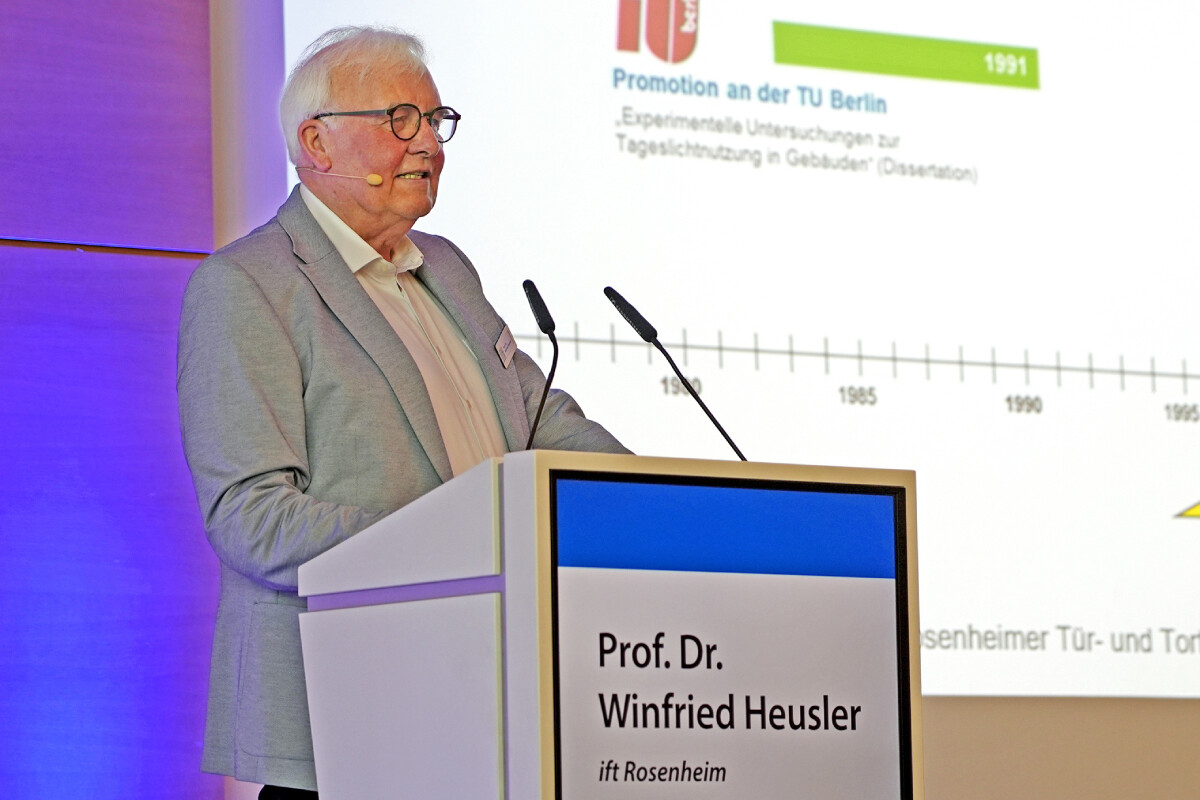
Photo: ift Rosenheim
Prof. Dr.-Ing. Winfried Heusler, Director of ift Rosenheim, outlined the key risks and opportunities for the door and gate industry during his presentation
European door and window manufacturers face new challenges from new regulation and digitalisation
ID no: 24354




Sep 22, 2026


Today 19:31